

Are you wondering about the role the Federal Reserve plays in setting mortgage rates? Then you are where you need to be. To answer your question, “how does the federal reserve affect mortgages?”, it does not set the rates outright. However, decisions taken by the Federal Reserve can affect the percentages lenders offer a prospective homebuyer. Even if the Fed does not alter its benchmark rate, mortgage rates can still rise or drop.
In this article, our experts at ALT Financial Network, Inc. will explain how the monetary policy of the Federal Reserve affects mortgages, and how it dictates your ability to purchase a home. Before we go into that, though, here is an overview of the Fed’s latest meeting.
At the latest meeting of the Federal Reserve, which took place on March 17-18, the Federal Open Market Committee (FOMC) cast its vote to hold its benchmark interest rate steady, just as it did in January. Three consecutive meetings followed it where the Fed cut rates. The FOMC even released a new round of economic projections. It is the first since its meeting in December.
According to Mike Fratantoni, the chief economist for the Mortgage Bankers Association, “The FOMC projections released after this meeting showed that the median member expects higher inflation in 2026. It also showed that little changed with respect to the economic growth outlook, which had been published in December.” He further added, “A growing number of FOMC members now expect no cuts – or at most, one – to the federal funds target this year, likely due to a more negative inflation outlook. This is a noticeable but predictable pullback from what had been published in December.”
The war in Iran should also be considered. It has constricted the entire world’s oil supply and increased fuel prices and the costs of other goods. The resulting inflation has increased bond yields, including that of the 10-year Treasury bond – and mortgage rates.
The next FOMC meeting is in April 28-29. Whatever happens in that meeting will depend on inflation developments and employment data. Geopolitical events will also be taken into consideration.
How Fed Rate Cuts Affect Mortgages
The U.S. Federal Reserve changes the federal funds rate to set the borrowing costs for short-term loans. This rate controls how much banks pay each other in interest to borrow funds from their reserves, kept at the Fed on an overnight basis. This rate is not the same as the rate you will pay for your mortgage. Nonetheless, they are connected. When the cost for banks to borrow increases or decreases, the cost for you to borrow increases or decreases the same way. When the Fed cuts the federal funds rate, it usually encourages lenders to reduce interest rates across the board. Simultaneously, if the Fed raises the rates, lenders will probably do the same.
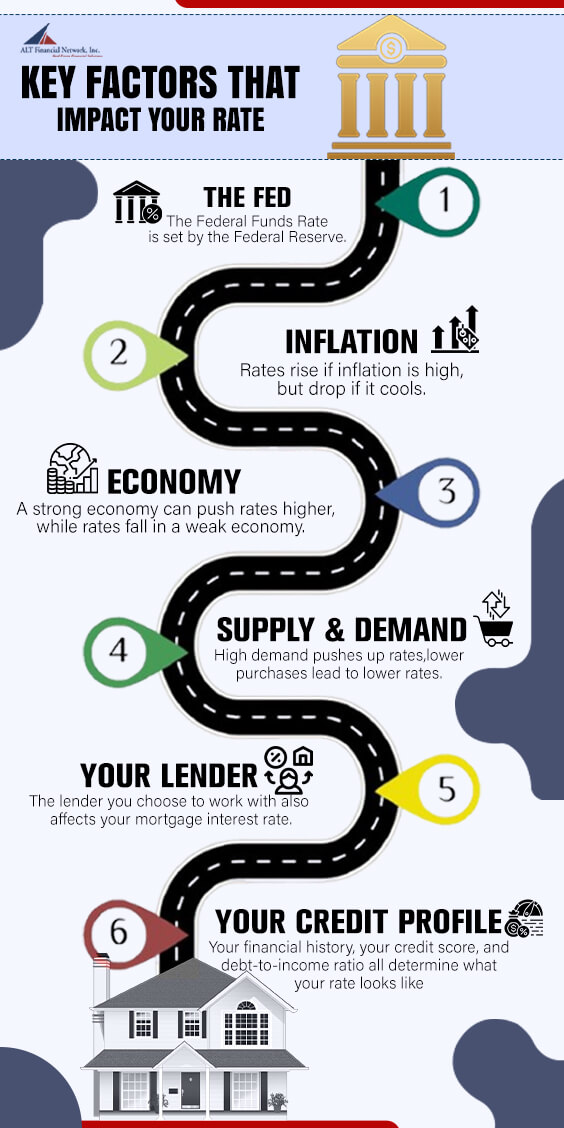
For instance, in 2022 and 2023, the Fed increased the key interest rate to dampen inflation. This hike made it costlier for the people of America to borrow money or take out credit. Then again, there are times when mortgage rates seem to ignore the Fed. In fact, the Fed cut the rate three times at the end of 2024. Unfortunately, mortgage rates stayed high, and even increased.
There is a reason behind this, of course. Fixed-rate mortgages, which are the most popular type of home loan, do not replicate the federal funds rate. Instead, they keep tabs on the 10-year Treasury yield. When it goes up or down, the rates of fixed-rate mortgages do, too.
Our mortgage broker in California would like to state this once more: the two rates are not the same. Your mortgage rate will be higher than the 10-year yield by an amount known as spread or margin. This spread widens as lenders factor in more risk.
Generally, the gap between the 10-year Treasury yield and the 30-year fixed mortgage rate spans 1.5 to 2 percentage points. For most of 2023 and 2024, the spread increased by 3 percentage points, adding to the cost of mortgages. The added risk in the marketplace due to rapidly rising rates is the primary cause.
Changes in mortgage rates can also be the result of:
- Inflation: Usually, when inflation picks up, fixed interest rates follow suit.
- Supply and Demand: If a mortgage lender has too much business, they crank up the rates to decrease demand. If business drops, they tend to cut rates to bring in more customers.
- Secondary Mortgage Market: The secondary mortgage market is where investors buy mortgage-backed securities. Most lenders bundle the mortgages they underwrite and sell them in the secondary marketplace to investors. When investor demand goes up, mortgage rates come down. When investors stop buying, rates can climb to attract them.
The Fed even buys and sells debt securities in the financial marketplace. This facilitates credit flow, which tends to have a significant impact on mortgage rates.
The Fed and Adjustable-Rate Mortgages (ARMs)
As we already mentioned, fixed-rate mortgages dominate the U.S. residential financing scene. However, it is not the first choice of every American. Some people prefer adjustable-rate mortgages (ARMs) with variable interest rates that reset annually or semi-annually. What the Fed does affects them more directly.
To be specific, the ARM rate is often tied to the Secured Overnight Financing Rate, or SOFR. As the Fed’s rate decisions serve as a basis for savings instruments, raising or lowering the fed funds rate can push the SOFR up or down. ARM rates, in turn, go up or down when the rate resets.
All of this means that if the federal funds rate goes up, your ARM rate will increase in the next adjustment.
What the Federal Reserve Did to Impact Mortgage Rates
As a way to respond to the economic effects of COVID-19, the Fed cut the federal funds rate to almost zero. While 30-year mortgage rates di not fall to the same degree, they did reach historic lows. The average 30-year mortgage rate dropped out at 2.97 percent in February 2021.
The Fed bumped up the rate consistently starting in March 2022 when inflation rose up and the U.S. made its way out of the pandemic. The federal funds rate reached 5.33 percent in August 2023, where it stayed until the end of September 2024. The funds rate and mortgage rates started growing simultaneously, with the 30-year rate breaching 8 percent in October 2023.
The Fed cut its rate three times at the end of 2024 in September, October, and December meetings, resulting in a total of 100 basis points. Even then, the mortgage rates remained upward-bound, often averaging above 7 percent.
For most of the first half of 2025, rates stayed between 6.8 percent and 7.1 percent. Then the Fed made three cuts in September, October, and December, totaling 75 basis points. Rates finished the year around the 6.25 percentage mark. In February 2026, the rates went as low as 6.09%, before rising above 6.25% in March.
Wrapping Up
Regardless of how does the Federal Reserve affect mortgages or its current policy, there are a few best practices that can get you the lowest mortgage rate every time. You just need to maintain solid credit, keep your debt low, and make as large a down payment as you can and shop around for loan offers.
When you are comparing rates, look at the Annual Percentage Rate (APR) instead of just the interest rate. A few lenders advertise low interest rates, but offset them with high fees. When you know your APR, you can contemplate your actual, all-in cost.
FAQs
1. Do mortgage rates change immediately after a Federal Reserve decision?
No, mortgage rates do not always change immediately after a Fed decision. Markets often react in advance based on expectations, so rate changes may happen before or after official announcements.
2. Why do mortgage rates sometimes rise even when the Fed cuts rates?
Mortgage rates can rise after Fed cuts due to inflation concerns, bond market activity, or investor behavior. These factors influence long-term rates more than the Fed’s short-term policy changes.
3. How can borrowers prepare for changing mortgage rates?
Borrowers can prepare by improving credit scores, reducing debt, saving for a larger down payment, and monitoring market trends. Being financially ready helps secure better loan terms when rates shift.
4. Are fixed mortgage rates more stable than adjustable-rate mortgages?
Yes, fixed-rate mortgages remain stable over time, while adjustable-rate mortgages can change periodically. ARMs are more sensitive to market changes and can increase or decrease after the initial period.
5. What role does inflation play in long-term mortgage trends?
Inflation is a key driver of long-term mortgage rates. When inflation rises, lenders increase rates to offset risk. When inflation slows, mortgage rates may stabilize or decrease over time.

